
Solar Panel Bird Mesh vs Spikes: Which Works Better?
If you’re dealing with pigeons nesting under your solar panels, you’ve probably come across two common solutions:
- bird spikes
- and bird proofing mesh
At first glance, spikes might seem like the cheaper and easier option.
But from our experience working on solar panel bird proofing jobs across Sydney, mesh barriers are usually far more effective for long-term protection under solar panels.
The reason comes down to one simple difference:
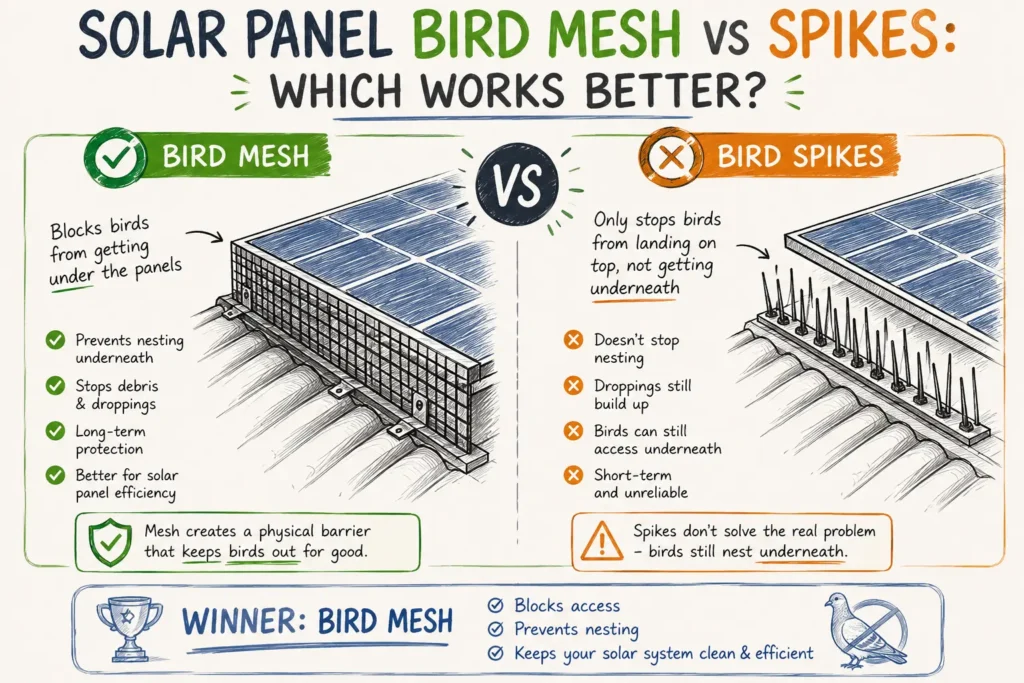
Mesh blocks access underneath the panels.
Spikes do not.
Why Birds Nest Under Solar Panels in the First Place
Solar panels create a sheltered gap between the roof and the underside of the panels.
For pigeons, that space is ideal for:
- nesting
- hiding from weather
- protection from predators
- and raising young
Once pigeons decide your roof is a good nesting location, they often keep returning to the same spot repeatedly.
That’s why proper prevention matters.
If the birds can still physically access underneath the panels, the problem usually continues no matter how many deterrents are added around the roof.
You can also read our guide on preventing birds nesting under solar panels for more prevention tips and early warning signs.
How Bird Mesh Works
Bird proofing mesh works by creating a physical barrier around the perimeter of the solar panels.
The mesh closes the gap between:
- the roof
- and the underside of the panels
This stops pigeons from being able to crawl underneath.
In simple terms:
the mesh acts like a wall.
A bird can land on the roof, but it can’t physically get under the solar system.
When installed properly, mesh systems:
- fully seal the perimeter
- allow airflow around the panels
- and provide long-term protection against nesting
Our solar panel bird proofing service in Sydney uses stainless steel mesh and specialised solar clips designed specifically for solar systems without drilling into the roof or panels.
How Bird Spikes Work
Bird spikes are designed to stop birds landing on specific flat surfaces.
They work reasonably well on:
- window ledges
- handrails
- signs
- fences
- and similar landing areas
But solar panels are a completely different situation.
The issue with solar panels is not birds landing on top.
The issue is birds accessing underneath.
Spikes don’t physically block the underside of the panels.
Most spike systems still leave large gaps where pigeons can:
- land beside the spikes
- walk around them
- or squeeze between them
We often explain it like this to homeowners:
Spikes are not a wall.
They’re just a landing deterrent.
The pigeons simply land nearby and walk through the gaps until they reach the space underneath the panels.
Why Mesh Usually Works Better Than Spikes
From our experience, mesh is usually far more effective because it solves the actual problem:
access underneath the solar panels.
Spikes only try to discourage birds from landing in one specific spot.
That’s why we regularly see homes where:
- spikes were already installed
- pigeons ignored them completely
- and nesting continued underneath the panels anyway
We’ve attended many Sydney jobs where homeowners had already tried:
- spikes
- fake owls
- sound deterrents
- plastic barriers
- and DIY solutions
Eventually they installed proper perimeter mesh and the problem was finally resolved.
In many cases, customers tell us they haven’t had issues again for years afterwards.
Common Problems With Bird Spikes on Solar Panels
1. Spikes Don’t Fully Block Access
This is the biggest issue.
Pigeons can usually:
- walk through the gaps
- climb around them
- or land nearby
The spikes don’t actually seal the perimeter underneath the panels.
2. Spikes Often Make Proper Installation Harder Later
This is something homeowners rarely think about.
We regularly see spikes:
- glued onto roofs with silicone
- drilled into roofing materials
- or installed exactly where proper mesh should go later
That creates extra labour because the spikes need to be removed before a proper mesh system can be installed.
In some cases, drilling also risks unnecessary roof damage.
3. Cheap Spikes Can Fail Over Time
We’ve seen spikes:
- come loose
- fall into gutters
- get stuck underneath panels
- trap debris
- and create additional cleanup issues
Meanwhile, the pigeons are often still nesting on the roof anyway.
4. Spikes Don’t Address Existing Nesting
If pigeons are already nesting underneath the panels, spikes usually do very little to stop them continuing to return.
The birds already know how to access the area.
That’s why physical perimeter protection is generally much more reliable.
What Makes a Good Solar Panel Mesh Installation?
Not all mesh installations are equal.
A proper installation should:
- fully close the perimeter
- avoid leaving gaps around corners or roof obstacles
- use secure solar clips
- avoid drilling into the roof or panels
- use quality materials
- and remain firmly tensioned long term
We’ve seen many failed DIY jobs where:
- cheap plastic mesh deteriorated in the sun
- corners were left open
- mesh was installed loosely
- or only part of the array was enclosed
If pigeons can still find an opening, they usually will.
You can also read our guide explaining what happens if bird proofing is ignored for too long.
Can DIY Mesh Work?
DIY mesh installations can work if:
- proper materials are used
- the perimeter is fully sealed
- and the installer understands roofing safety and solar panel layouts
The issue is that many DIY attempts use:
- unsuitable mesh
- poor fastening methods
- incomplete coverage
- or cheap materials that don’t last
That’s why we often get called to repair or replace failed DIY systems later.
So Which Works Better?
For solar panels specifically:
mesh is almost always the better long-term solution.
Spikes may work for:
- ledges
- fences
- railings
- and flat surfaces
But when it comes to stopping birds nesting underneath solar panels, properly installed mesh barriers are far more effective because they physically block access to the nesting area.
Final Thoughts
If you’re trying to decide between spikes and mesh for solar panels, the most important thing to remember is this:
The goal is not just stopping pigeons from landing.
The goal is stopping them from getting underneath the panels.
That’s why perimeter mesh systems consistently work better on solar panel systems than spikes alone.
Whether you choose to install it yourself or hire a professional, using the right materials and properly sealing the perimeter makes a huge difference long term.
FAQs
Is professional bird proofing worth it?
For many homeowners, professional bird proofing helps avoid ongoing nesting, roof contamination, gutter blockages and repeated failed DIY attempts.
Can birds still get through poorly installed mesh?
Yes. If gaps are left around corners, roof penetrations or edges, pigeons can often still access underneath the panels.
What type of mesh is best for solar panels?
Stainless steel mesh systems designed specifically for solar panels are generally the most durable and reliable option long term.
Can spikes damage the roof?
They can if they are drilled into roofing materials incorrectly. We also commonly see spikes glued onto roofs with silicone, which can make future bird proofing installations harder.
Why don’t bird spikes work well on solar panels?
Bird spikes don’t fully seal the gap underneath the panels. Pigeons can often land nearby and walk around or through the spikes.
Is mesh better than spikes for solar panels?
Yes. Mesh barriers physically block birds from accessing underneath the solar panels, while spikes mainly discourage birds from landing in certain spots.