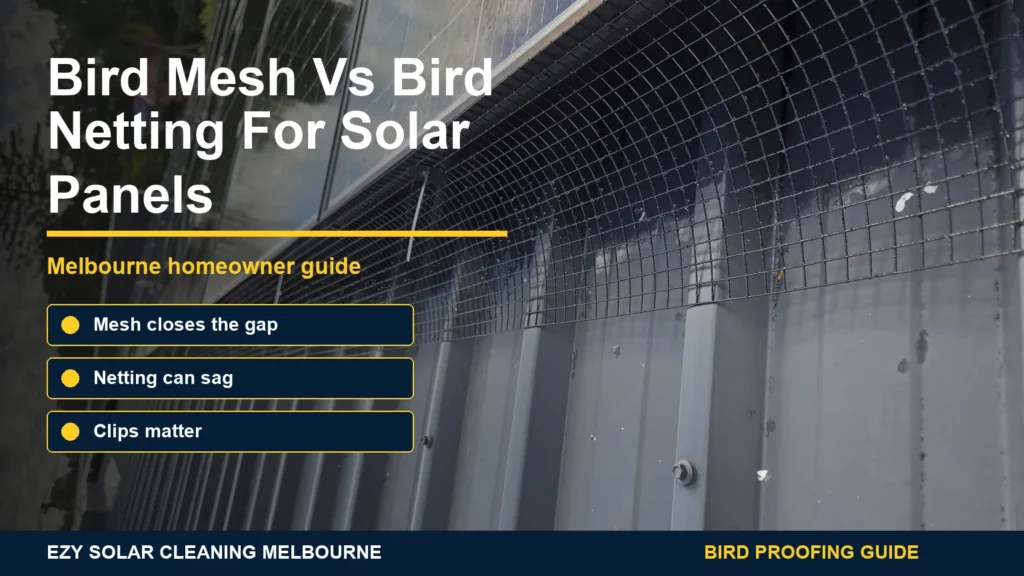
Bird Mesh Vs Bird Netting For Solar Panels
For solar panels, bird mesh is usually the better option than general bird netting. Mesh is designed to create a firm barrier around the edge of the solar array, while netting is often made for larger open spaces and can be harder to fit neatly around panel frames.
The aim of solar panel bird proofing is not to trap birds or cover the whole roof. The aim is to stop pigeons getting into the sheltered gap underneath the panels.
That job needs a neat, durable, full-perimeter barrier. In most cases, that means bird mesh rather than loose netting.
The Difference Between Mesh And Netting
Bird mesh and bird netting can sound similar, but they are not the same in practice.
| Option |
How It Is Usually Used |
| Bird mesh |
Fitted around the solar panel perimeter to block access underneath. |
| Bird netting |
Often used across larger areas, openings, gardens, balconies, or structural spaces. |
Solar panels need a barrier that follows the panel edges. Loose netting can be difficult to tension neatly and may not create the clean perimeter finish needed for a solar array.
Why Solar Panels Need A Physical Barrier
Pigeons nest under solar panels because the gap gives them shelter, shade, and protection from disturbance. If that gap stays open, they can return even after nests are removed.
The solution needs to physically close the access point. It does not need to scare birds away from the whole roof. It needs to stop them getting underneath the panels.
That is why mesh works well for solar bird proofing. It can be fitted around the panel edges so the sheltered cavity is blocked while airflow is still allowed.
For the main service, see
solar panel bird proofing in Sydney.
Why Netting Can Be The Wrong Fit
General bird netting may be useful in some settings, but solar panels have specific requirements. The material has to sit neatly near panel frames, brackets, corners, and roof surfaces.
Netting can create problems when it:
- sags between fixing points
- looks messy from the ground
- moves in wind
- does not sit cleanly around panel corners
- leaves gaps near the roof surface
- is attached using unsuitable methods
- covers more area than needed
A messy barrier can be both unattractive and less reliable. Birds only need one opening to keep testing the space under the panels.
What Good Bird Mesh Should Do
Good solar bird mesh should create a clean edge around the solar panels. It should block pigeons without making the roof look rough.
A proper mesh installation should:
- cover the full perimeter
- fit neatly around corners
- use solar-specific clips
- avoid drilling into panels or roof surfaces
- hold its shape
- allow airflow under the panels
- blend with the panel frame where possible
For a simple explanation of the product, see
what bird mesh is for solar panels.
Mesh Does Not Mean Blocking Airflow
Some homeowners worry that bird mesh will seal the panels too tightly. Proper mesh should not work like a solid wall. It is a ventilated barrier that stops birds entering while still allowing air movement under the panels.
The issue is workmanship. Mesh should be fitted carefully so it blocks bird access without covering the solar glass or smothering the underside of the system.
Unsuitable netting or makeshift materials can create a messier result because they are not shaped specifically for the panel edge.
Appearance Matters Too
On many Sydney homes, panels are visible from the street, driveway, or outdoor living area. That means the finished bird proofing should look neat.
Black mesh usually blends better with dark solar panel frames. General netting may look more obvious if it sags, catches light, or stretches across areas that do not need covering.
A good solar bird proofing job should be fairly boring to look at: neat edges, firm mesh, clean corners, and no loose hanging material.
What About Spikes?
Spikes are another common comparison, but they solve a different problem. Spikes can discourage birds from landing on a specific ledge, but they do not close the gap under solar panels.
A pigeon may land nearby, walk around the spikes, and still enter underneath if the panel cavity is open.
For that comparison, see
solar panel bird mesh vs spikes.
When Netting Might Be Mentioned In Quotes
Some companies or homeowners use the word netting loosely when they really mean mesh. That is why it is worth asking exactly what will be installed.
Before booking, ask:
- Is this proper solar bird mesh or general netting?
- What material is it made from?
- How is it attached?
- Will it cover the full perimeter?
- Will it be fitted without drilling?
- How will corners and side gaps be closed?
If the quote is unclear, get clarification before approving the job.
The Bottom Line
Bird mesh is usually better than bird netting for solar panels because it is designed to close the gap around the panel perimeter. General netting can sag, look messy, and be harder to fit neatly around solar panel edges.
For Sydney homeowners dealing with pigeons under solar panels, the goal is a neat physical barrier that blocks access and holds its shape over time. The right material, clips, and workmanship matter more than simply putting any barrier on the roof.
FAQs
Is bird mesh the same as bird netting?
No. Mesh is usually a firmer barrier fitted around panel edges, while netting is often used across larger open areas and may not suit solar panel perimeters.
Why is mesh better for solar panels?
Mesh can be fitted around the full panel perimeter to block birds from entering underneath while keeping the job neat.
Can bird netting sag?
Yes, general netting can sag or move if it is not suited to the application or fitted poorly.
Does bird mesh stop birds landing on the roof?
No. Mesh stops birds getting under the panels. Birds may still land on the roof or inspect the area at first.
Should mesh be drilled into the panels?
No. Professional solar bird mesh should generally use solar-specific clips and avoid drilling into panels or roof surfaces.
Can mesh be added after panels are installed?
Yes. Most bird proofing jobs are retrofit installations added after solar panels are already on the roof.