
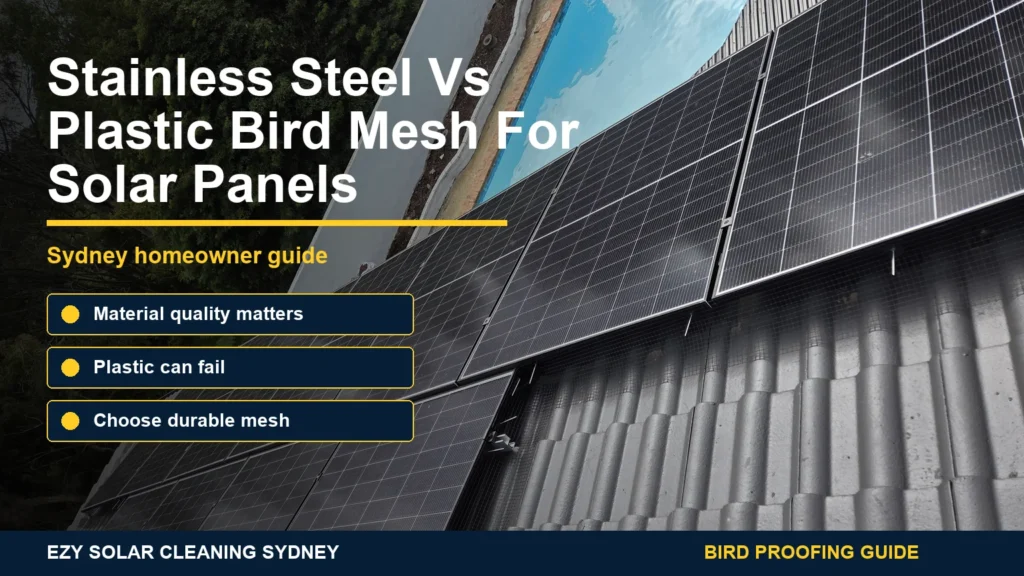
Stainless Steel Vs Plastic Bird Mesh For Solar Panels
When you are choosing bird mesh for solar panels, the material matters. For most Sydney homes, PVC-coated stainless steel mesh is the better long-term option because it is stronger, holds its shape better, and is more suitable for harsh rooftop conditions than cheap plastic mesh.
Plastic mesh may look fine when it is first installed, but roofs are tough places. Sun, heat, wind, rain, nesting pressure, and birds testing the edges can all expose weak material fairly quickly.
The short version is this: bird mesh is not just there to “cover a gap”. It has to stay firm around the solar panel edges for years, without sagging, cracking, pulling away, or leaving new entry points.
Why Mesh Material Matters So Much
Pigeons are persistent. If they have been nesting under solar panels, they will often keep checking the same roof area even after a barrier is fitted.
That means the mesh has to deal with more than just weather. It also has to deal with birds landing nearby, walking along the panel edges, and testing weak spots.
A good bird mesh setup should:
- physically block access under the panels
- hold its shape around the panel edge
- stay secure at corners and joins
- handle Sydney rooftop conditions
- avoid looking messy from the ground
- work with solar-specific clips
- allow airflow under the panels
- avoid drilling into the roof or solar panels
This is why material quality and installation quality go together. Good mesh installed badly can still fail. Cheap mesh installed neatly may still age poorly.
For the main service overview, see solar panel bird proofing in Sydney.
Stainless Steel Mesh: The Stronger Option
Stainless steel mesh is used because it gives the barrier strength. When it is PVC-coated, it also has a cleaner black finish that blends better with most solar panel frames.
For solar panel bird proofing, stainless steel mesh is usually preferred because it is:
- stronger than plastic mesh
- harder for birds to push through
- less likely to stretch out of shape
- better suited to rooftop exposure
- neater when fitted properly
- more reliable around panel edges and corners
The black coating also matters for appearance. A neat black mesh usually sits quietly against the dark frame of the panels, which is important for homeowners who do not want the roof to look messy.
A good installation should look tight, controlled, and deliberate, not like wire has been wrapped around the panels as an afterthought.
Plastic Mesh: Why It Can Be A Problem
Plastic mesh can be tempting because it is often cheaper. The problem is that cheap materials are rarely a good match for a hot, exposed roof.
Plastic mesh may:
- become brittle over time
- sag between fixing points
- stretch or warp
- crack in strong sun
- look untidy as it ages
- be easier for birds to test or disturb
- pull away from corners if poorly fitted
The issue is not always obvious on day one. A plastic mesh job can look acceptable at first, especially from the ground. The real question is how it performs after months of heat, rain, wind, and pigeon activity.
Bird proofing should be a long-term prevention service. If the mesh fails early, the homeowner may end up paying twice: once for the cheap install, then again to remove or replace it properly.
The Main Difference Is Long-Term Shape
A bird proofing barrier has to keep its shape. That is one of the biggest differences between stainless steel mesh and plastic mesh.
If mesh starts sagging, bowing, or pulling away, pigeons may find a way back underneath the panels. Birds do not need a large opening. A weak corner or loose lower edge can be enough for them to keep testing the area.
| Feature | PVC-Coated Stainless Steel Mesh | Plastic Mesh |
|---|---|---|
| Strength | Stronger and more rigid | Usually weaker and more flexible |
| Rooftop durability | Better suited to long-term exposure | More likely to become brittle or sag |
| Appearance | Black coating can blend with panels | Can look cheaper as it ages |
| Bird resistance | Harder for pigeons to push or distort | Easier to disturb if weak or loose |
| Best use | Long-term solar bird proofing | Short-term or low-quality installs to avoid |
This is why the cheapest quote is not always the best value. The right question is not only “how much does it cost?” It is “what material is being installed, and will it hold up?”
For cost-related checks, see the Sydney bird proofing pricing guide.
Coating And Colour Matter Too
The coating is not just about looks. For solar bird proofing, black PVC-coated stainless steel mesh is usually preferred because it gives a neater finish and helps the mesh blend with the panel frame.
From ground level, black mesh is generally less noticeable than shiny metal, light-coloured plastic, or mismatched netting.
A neat finish is especially important when:
- panels face the street
- panels sit close to the gutter line
- the roof is low or highly visible
- the home has a clean front elevation
- the homeowner cares about street appeal
Bird proofing should solve the pigeon issue without making the roof look rough. If the material looks cheap or the edges are untidy, the finished job can stand out for the wrong reason.
Mesh Is Only As Good As The Installation
Material is important, but it is not the whole job.
A proper installation should use the right mesh with the right fixing method. For solar panels, that usually means solar-specific clips, careful tensioning, and no drilling into the roof or panels.
Good workmanship includes:
- fitting the mesh around the full perimeter
- keeping the mesh firm but not messy
- shaping corners neatly
- closing small side gaps
- working around brackets and roof features
- checking every panel edge
- removing nests and debris where needed
- taking before and after photos
Poor workmanship can make even good mesh perform badly. If corners are left open or clips are spaced badly, pigeons may keep finding weak points.
For more on the material itself, see what bird mesh is for solar panels.
Why Cheap Mesh Can Cost More Later
Cheap mesh often looks like a saving at the quote stage. The problem is what happens if it fails.
If birds get back under the panels, the homeowner may have to deal with:
- more nesting material
- more droppings
- another clean-out
- another installation cost
- messy old mesh removal
- frustration from thinking the problem was already fixed
This is especially frustrating because pigeons are often location-oriented. If they have nested under the panels before, they may keep returning to check the same area. A weak barrier gives them a reason to keep trying.
A stronger mesh and careful installation reduce that risk.
What About Chicken Wire Or General Netting?
Chicken wire and general-purpose netting are not ideal for solar panel bird proofing.
They may be cheap and easy to buy, but they are not designed for a neat solar panel perimeter installation. They can look messy, corrode or age poorly depending on the material, and may not sit cleanly around panel edges.
The problem with makeshift materials is that they often focus on covering the visible gap, not creating a neat, durable, full-perimeter barrier.
For solar panels, the aim is not just to “put something there”. The aim is to stop pigeons entering while keeping the roof and solar system tidy.
When Cleaning Should Be Considered
If birds have already been nesting under the panels, the mesh material is only one part of the job. There may also be droppings, feathers, nesting material, and grime around the roof and panel area.
Cleaning may be worth considering when:
- droppings are on the solar glass
- debris has built up under the panels
- gutters have been affected
- the roof area looks stained or dirty
- the homeowner wants the system tidied up after bird activity
Cleaning can improve appearance and remove contamination. It may help performance where heavy build-up was blocking sunlight, but results vary depending on the system, shading, weather, and how dirty the panels were.
For service details, see solar panel cleaning in Sydney.
How To Compare Quotes Properly
When comparing stainless steel mesh and plastic mesh, do not compare price alone. Ask what is actually included.
Before booking, ask:
- What type of mesh will be used?
- Is it PVC-coated stainless steel or plastic?
- How will it be attached?
- Are solar-specific clips used?
- Will there be drilling into the panels or roof?
- Is the full perimeter included?
- Are corners and side gaps properly closed?
- Is nest and debris removal included if needed?
- Will before and after photos be provided?
A professional quote should make the material and installation method clear. If the quote only says “bird mesh installed” without detail, ask for clarification.
The Bottom Line
For solar panel bird proofing, PVC-coated stainless steel mesh is usually the better choice over plastic mesh. It is stronger, more durable, better suited to rooftop conditions, and more likely to hold its shape around the solar panel edges.
Plastic mesh may be cheaper, but it can sag, crack, stretch, or fail sooner, especially in exposed roof conditions. If pigeons find a weak point, the problem can start again.
For Sydney homeowners, the best result is not just bird mesh. It is the right mesh, fitted properly, around the full perimeter, with neat workmanship and no unnecessary drilling into the solar panels or roof.
FAQs
Is stainless steel mesh better than plastic bird mesh?
Yes, for most solar panel bird proofing jobs, PVC-coated stainless steel mesh is the better option. It is stronger, more durable, and better suited to rooftop conditions than cheap plastic mesh.
Why is plastic mesh not ideal for solar panels?
Plastic mesh can become brittle, sag, stretch, or crack over time. If it pulls away from the panel edge, pigeons may find a way back underneath.
Does stainless steel mesh look ugly?
Not when it is installed neatly. Black PVC-coated stainless steel mesh usually blends well with the dark solar panel frame and is often barely noticeable from ground level.
Can birds push through weak mesh?
Persistent pigeons may keep testing weak points, especially if they have nested under the panels before. Loose, sagging, or poor-quality mesh can make this easier.
Should bird mesh be drilled into the panels?
No. Professional bird mesh should generally be fitted with solar-specific clips and should avoid drilling into the panels or roof.
Is chicken wire okay for solar panel bird proofing?
Chicken wire is not ideal. It can look messy, may not suit solar panel edges properly, and is not the same as a neat, purpose-fitted solar bird mesh system.
Is the mesh material more important than the installation?
Both matter. Good mesh can fail if it is installed badly, and a neat install with poor material may not last. The best result needs suitable mesh and careful workmanship.